July 2, 2026

If you need AC freezing up repair in Meridian right now, here’s what to do first:
Believe it or not, your air conditioner can freeze solid on the hottest days of a Meridian summer. It sounds backwards, but it happens all the time — and when it does, your home stops cooling fast.
Meridian summers regularly push into the mid-to-upper 90s. Your AC runs hard to keep up. That constant demand is exactly when restricted airflow or a low refrigerant charge can cause the evaporator coil to drop below freezing, coating it in ice and shutting down your comfort.
The good news? Most freeze-ups have a clear cause — and a clear fix. This guide walks you through exactly what’s happening and what to do about it.
Through our work at Upfront, we’ve seen how often AC freezing up repair in Meridian catches homeowners off guard during peak summer heat. Understanding the root cause is the fastest path to getting your home cool again.
AC freezing up repair Meridian vocab to learn:
To understand why your air conditioner transforms into an amateur ice rink in the middle of June 2026, we have to look at the science of cooling. Your AC doesn’t actually “create” cold air; instead, it removes heat from your indoor air.
This magic happens at the indoor evaporator coil. Extremely cold refrigerant circulates through this copper coil. As your indoor fan blows warm, humid air across the cold coil, the refrigerant absorbs the heat from the air. The newly cooled air is then pushed back into your living space, while the absorbed heat is carried outside to your condenser unit.
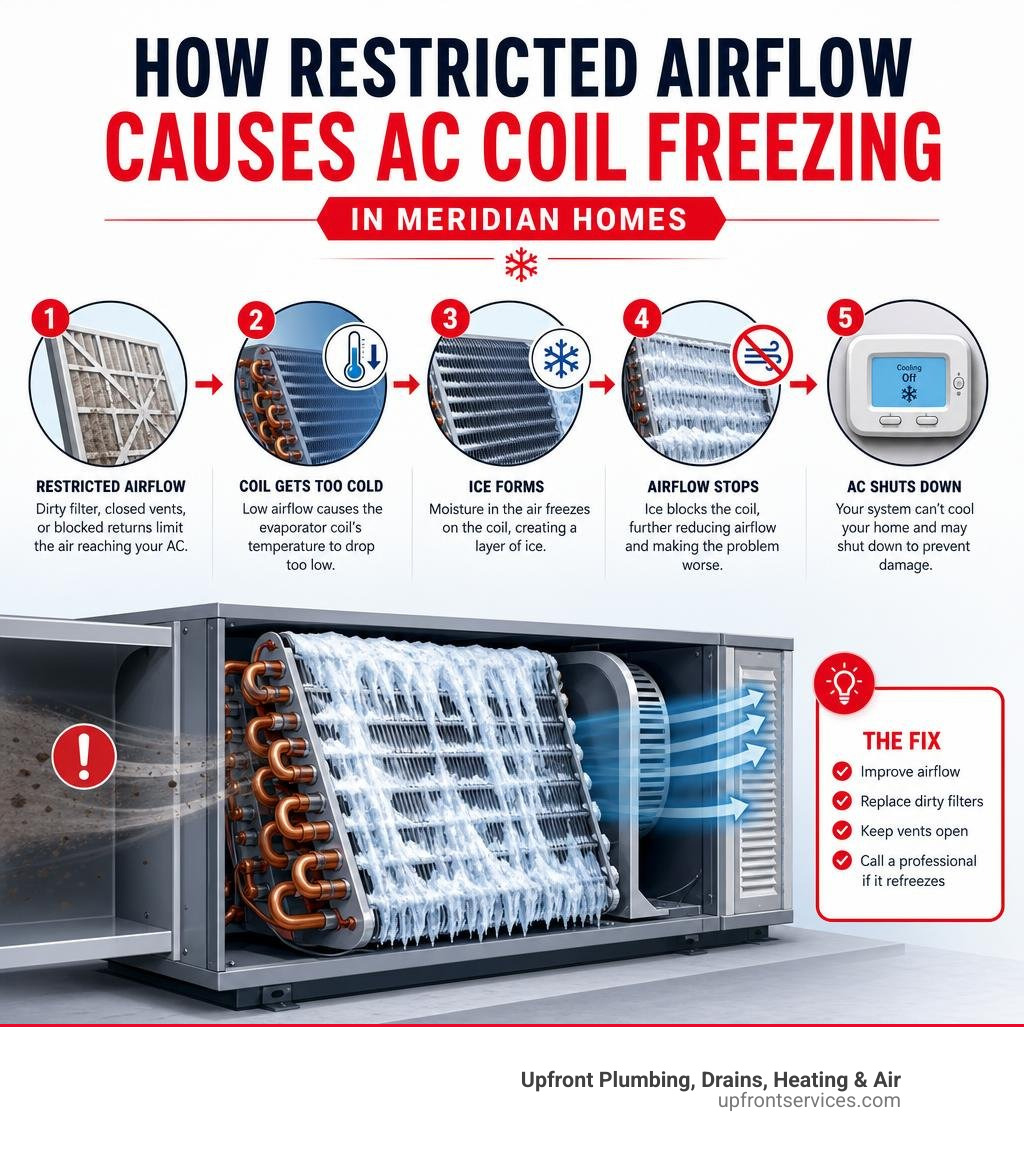
However, this delicate process relies on a perfect balance of airflow and refrigerant pressure. If anything disrupts this balance, the temperature of your evaporator coil will plummet below 32 degrees Fahrenheit. Any moisture or humidity pulled from your indoor air will instantly freeze onto the coil. Layer by layer, ice builds up until the entire coil is encased, completely blocking air from passing through.
In Meridian’s hot, dry summer climate, your cooling system is already working under high stress. When temperatures spike, any minor system bottleneck quickly escalates into a frozen disaster. Air conditioners in hot, dry regions like the Treasure Valley can experience up to a 30% reduction in airflow and a significantly increased risk of freezing when maintenance is neglected.
If your system has reached this point, continuing to run it will only cause severe, expensive damage to your compressor. Recognizing the signs early and scheduling an AC freezing up repair in Meridian is crucial to saving your system. To keep your unit running efficiently all summer long, check out our guide on The Boise AC Tune-Up That Saves Your Summer to prevent these blockages before they start.
If the refrigerant is the lifeblood of your air conditioner, then the blower fan motor is its beating heart. Without a strong, consistent stream of warm air passing over the evaporator coil, the heat exchange process halts entirely.
The blower fan is responsible for pulling warm air from your home through the return vents, pushing it across the evaporator coil, and distributing the cooled air back through your supply ducts. When the fan motor operates at its peak, the heat transfer is perfectly balanced: the warm air keeps the evaporator coil just warm enough to prevent it from dropping below freezing, while the coil cools the air to your desired temperature.
However, when airflow becomes restricted, this heat transfer drops. If your system has a dirty blower wheel, dust and debris accumulate on the fan blades, altering their aerodynamic curve. A dirty blower wheel alone can reduce system airflow by up to 30%. This lack of air volume means there is not enough heat passing over the coil to keep the refrigerant warm. Consequently, the coil’s temperature drops below freezing, and ice begins to accumulate.
To see how restricted airflow directly impacts your system’s operating metrics, review the comparison table below:
| Operating Parameter | Normal Airflow | Restricted Airflow (Dirty Blower/Filter) |
|---|---|---|
| Evaporator Coil Temp | 40°F to 45°F (Safe Range) | Below 32°F (Freezing Range) |
| Air Volume (CFM) | 100% Design Capacity | Reduced by 30% or more |
| Heat Exchange Efficiency | High / Optimal | Extremely Low |
| System Pressure | Balanced and Stable | Low Pressure (Triggers Icing) |
| Freeze Risk | None | Extremely High |
When a blower motor begins to fail, it directly impacts the system’s internal pressure and operating temperature. A motor that is dragging, suffering from worn bearings, or dealing with a failing run capacitor will spin the fan at a much lower speed than required.
This drop in fan speed means the volume of warm air passing over the evaporator coil is severely reduced. As the heat transfer rate drops, the liquid refrigerant inside the coil does not fully evaporate into a gas. This causes the pressure inside the evaporator coil to drop significantly.
In the HVAC world, pressure and temperature are directly linked. When the pressure inside your refrigerant lines drops, the temperature of the refrigerant drops along with it. Once that temperature falls below 32 degrees, any condensation on the coil turns to ice. This ice acts as an insulator, further blocking what little airflow was left, creating a rapid feedback loop of ice accumulation.
If your fan motor has died completely, or if you suspect your system is on the verge of a total breakdown during a blistering Idaho heatwave, you need prompt professional assistance. Learn how to handle these urgent situations by reading our guide on Emergency HVAC Near Me: A Guide to Rapid Relief.
Your blower fan motor rarely fails without warning. By keeping an eye—and an ear—out for these common warning signs, you can catch a failing motor before it causes your entire system to freeze solid:
If you notice any of these red flags, it is time to bring in the professionals. Discover how we can help keep your home comfortable with our Professional AC repair in Meridian with Upfront.
Finding a block of ice where your air conditioner should be can be frustrating, but there are several safe troubleshooting steps you can perform before calling for professional backup.
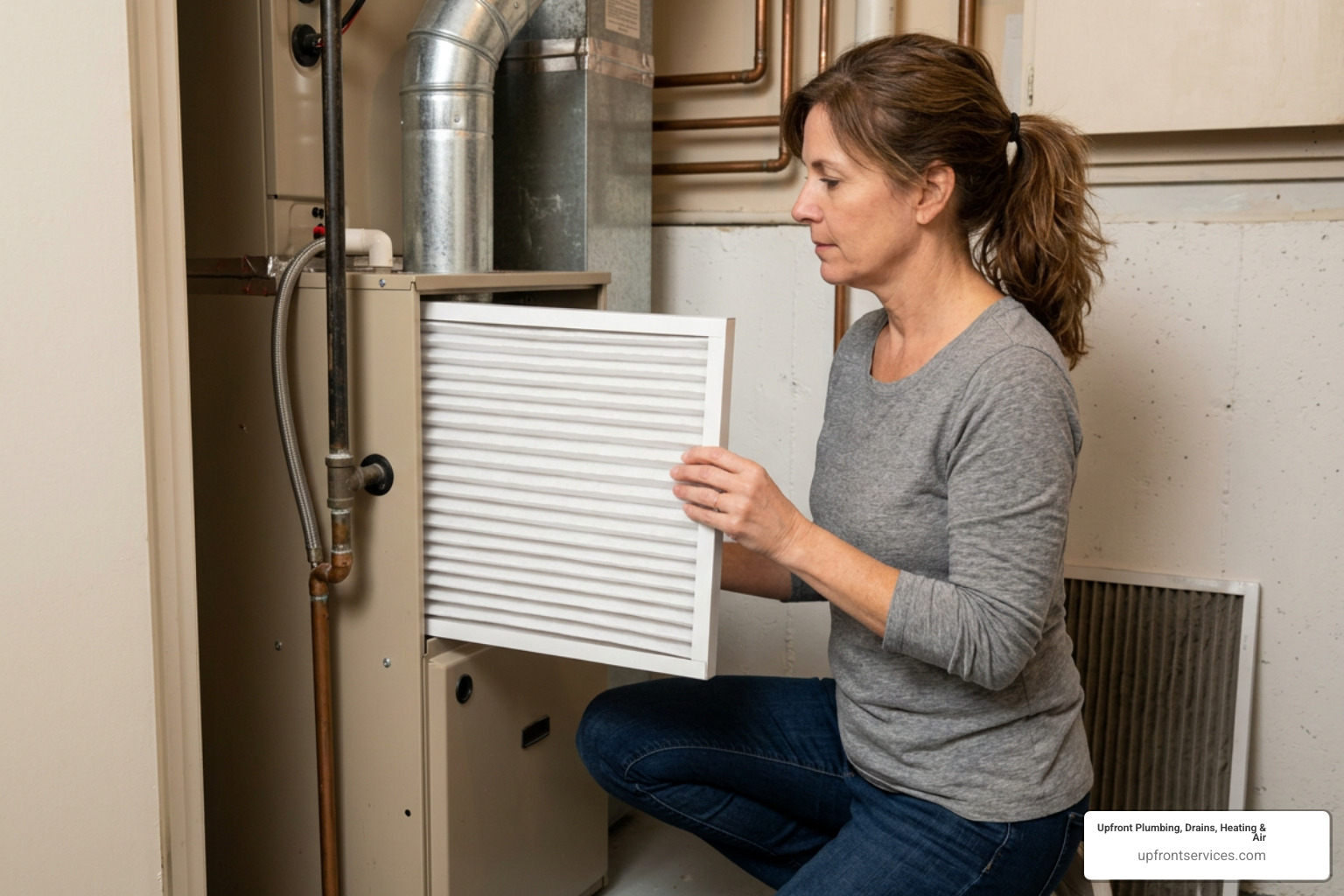
If you find your air conditioner frozen, follow this step-by-step checklist immediately to protect your equipment and begin the thawing process:
If you have completed these steps, allowed the system to thaw completely, and find that it immediately freezes up again upon turning the cooling back on, you have an underlying mechanical or refrigerant issue that requires professional diagnostic tools. Our team is always ready to help diagnose and resolve these complex airflow and refrigerant issues safely.
No, it is absolutely not safe to continue running your air conditioner if it is freezing up. When the evaporator coil is covered in ice, the heat exchange process stops. This means the liquid refrigerant circulating through the system does not absorb enough heat to expand into a gas before it travels back to the outdoor unit.
If liquid refrigerant flows back into your outdoor compressor—a dangerous phenomenon known as “liquid slugging”—it will destroy the compressor’s internal pistons and valves. Compressors are designed to compress gas, not liquid. Running a frozen system can turn a simple airflow repair into a complete system replacement. If you see ice, shut the system down immediately and run the fan on “On” mode to thaw it safely.
It sounds counterintuitive that having less cooling chemical (refrigerant) in your system would make it freeze more, but it all comes down to pressure.
Your air conditioner operates as a closed, pressurized loop. If there is a refrigerant leak, the overall pressure within the system drops. According to the laws of physics, as pressure drops, the temperature drops. The remaining refrigerant inside the evaporator coil expands much more than it is designed to, causing its temperature to plummet well below 32 degrees Fahrenheit.
Any moisture in your household air that condenses on the cold coil instantly freezes into ice. Low refrigerant is a leading secondary cause of AC freeze-ups, and running a system undercharged can increase your energy consumption by 20% or more while putting immense strain on your compressor.
We highly recommend scheduling professional HVAC maintenance at least once a year, ideally in the spring before the intense summer heat hits the Treasure Valley. Annual maintenance is the single best way to protect your investment, reducing the likelihood of emergency breakdowns and freeze-ups by up to 50%.
During a professional tune-up, a technician will clean your evaporator and condenser coils, test your blower motor’s electrical draw, inspect the run capacitor, check refrigerant charge levels, and ensure your ductwork is delivering proper airflow. Combined with regular monthly filter changes at home, annual maintenance keeps your system running efficiently, lowers your energy bills, and extends the lifespan of your equipment.
If you are trying to find the right team for the job, check out our guide on How to Choose the Best Boise ID HVAC Contractors Without Losing Your Cool to ensure you get quality service. If your system is older and constantly freezing, you might also want to read about Replacing Your HVAC in Boise Without Breaking the Bank to see if an upgrade makes more financial sense.
A frozen air conditioner in the middle of a hot Meridian summer is a major headache, but it doesn’t have to ruin your week. By understanding how restricted airflow, dirty blower wheels, and failing fan motors contribute to frozen coils, you can take immediate action to protect your home and your HVAC equipment.
At Upfront, we are dedicated to providing our neighbors throughout Boise, Meridian, Nampa, Caldwell, Eagle, and Garden City with honest, upfront pricing, exceptional workmanship, and unmatched warranties. We don’t believe in high-pressure sales pitches or hidden fees—just reliable, professional service designed to keep your family comfortable all year long.
If your air conditioner is struggling, blowing warm air, or freezing up, don’t wait for a complete system breakdown. Schedule your Meridian AC service today and let our experienced, licensed technicians restore your home’s cool comfort safely and efficiently!
Our licensed team is available 24/7 across the Treasure Valley.

Reach out for fast, upfront service on any plumbing, drain, or HVAC issue — no obligation.
Get a No-Obligation Quote